The Last Message
Lore
Introduction
"More than 1,400 years ago, in the sandy alleys of Mecca, a message was revealed that would change the world forever..." Welcome to the universe of The Last Message. This game immerses you in 7th-century Mecca, a crossroads of cultures, trade, and beliefs. Through the eyes of a traveler who arrives for the great fair, you will witness key events that marked the beginning of a profound spiritual transformation.
The lore of the game draws from authentic historical events and the first revelations of Islam, combined with modern gameplay elements: exploration, quests, and progression. The player gradually uncovers the city's secrets, meets legendary figures of the time, and experiences the struggles faced by the earliest believers.
Historical Context
The Last Message takes place in the heart of the Arabian Peninsula, in the city of Mecca, over 1,400 years ago. It was a time deeply rooted in tribal traditions, ancient customs, and a polytheistic society structured around lineage, honor, and trade. Mecca was a thriving religious and commercial hub. Caravans from all regions converged there, drawn by the Kaaba, a sacred site surrounded by idols worshipped by the various Arab tribes.
The Quraysh, the dominant tribe, controlled the city and held great prestige as the guardians of the sanctuary. It was in this context that Muhammad ﷺ was born, a member of the Quraysh tribe, at a time of social, moral, and spiritual upheaval. The Arab world was immersed in Jahiliyyah — the "Age of Ignorance" — characterized by inequality, idolatry, and tribal violence.
Your adventure begins at a pivotal moment in history: just before the first divine revelations that would transform the fate of Mecca, the Arabian Peninsula, and eventually, the entire world.
Religions in Mecca Before Islam
Before the advent of Islam, Mecca was a religious and commercial hub where various beliefs coexisted. The majority of the Quraysh tribe, along with other Arab tribes, practiced tribal polytheism: they worshipped idols representing different deities, many of which were housed around the Kaaba — such as Hubal, Al-Lat, Al-Uzza, and Manat.
Each tribe had its own protective idols, and pilgrimages to the Kaaba were already common, although they were tied to pagan rituals. Alongside this, a minority of Jews and Christians lived in the region, particularly in nearby cities like Yathrib (later Medina). There was also a small group of monotheistic seekers known as Hanifs, who rejected idol worship and claimed to follow the religion of Abraham (Ibrahim). This religious diversity laid the groundwork for the emergence of Islam, which called for a return to pure monotheism.
Historical Monuments
The Kaaba
The Kaaba is the spiritual heart of Islam, a sacred cube located at the center of the Grand Mosque (al-Masjid al-Haram) in Makkah. Long before the rise of Islam, it was already a revered pilgrimage site among the Arabs, though it was filled with idols. According to Islamic tradition, it was built by Ibrahim (Abraham) and his son Ismail (peace be upon them). The Prophet Muhammad later purified it by removing the idols and dedicating it solely to the worship of Allah.
Dar al-Arqam
Dar al-Arqam was the house of one of the earliest companions, Al-Arqam ihn Ahi al-Arqam, located near the base of Mount Safa. It served as the first secret center of Islamic learning, where the Prophet (SAW) taught Islam to the earliest believers in secrecy. It was a safe haven, a place of knowledge, unity, and preparation for the challenges ahead.
The Cave of Hira (Ghar Hira)
Located on Mount Jabal al-Nour, the Cave of Hira holds deep symbolic and historical significance in Islam. The Prophet Muhammad & would retreat to this cave to meditate, away from the injustices and idol worship of his society. It was in this very cave that the angel Jibril (Gabriel) appeared to him for the first time, revealing the opening verses of the Qur'an: "Read in the name of your Lord who created..." (Surah Al-'Alaq).
Key Historical Events
The Year of the Elephant (570 CE)
In an attempt to divert pilgrims from the Kaaba, the Christian governor of Abyssinia, Abraha, marched toward Mecca with a large army, accompanied by a mighty war elephant named Mahmoud. As they approached the sacred city, a miraculous event occurred: flocks of birds sent by God pelted the army with burning clay stones, completely destroying them. This extraordinary moment is mentioned in the Qur'an (Surah Al-Fil), and the year of the attack became known as the "Year of the Elephant" - the very year when Muhammad was born.
The Birth of Prophet Muhammad
In that same year, Muhammad ibn Abdullah was born into the noble Banu Hashim clan of the Quraysh tribe. Orphaned before birth, and losing his mother at the age of six, he was raised first by his grandfather, then by his uncle Abu Talib. Despite these early hardships, Muhammad grew up known for his truthfulness, honesty, and wisdom - rare traits in a time marked by ignorance and injustice.
The Visit of Angel Jibril (Gabriel) During Childhood
As a young boy, Muhammad was playing with other children near Mecca when two angels descended upon him one of them was Jibril (Gabriel). They opened his chest, removed a black clot a symbol of evil and washed it in a golden bowl filled with Zamzam water. They then returned his purified heart to his chest. The frightened children ran to alert the adults. Though mysterious to those around him, this event already foretold the exceptional purity of the future Messenger of God ﷺ.
The Quraysh
The Quraysh were the most influential tribe in Mecca at the time of the birth of the Prophet Muhammad ﷺ. As guardians of the Kaaba, they held immense religious, economic, and social power across the Arabian Peninsula. Renowned for their commercial skill, they organized seasonal trade caravans to the north (Syria) and south (Yemen), further strengthening their dominance.
The tribe was divided into several clans, including the most notable:
- Banu Hashim: The clan of the Prophet Muhammad ﷺ, known for generosity and noble values.
- Banu Umayyah: A politically powerful clan, often in rivalry with Banu Hashim.
- Banu Makhzum: Known for their warriors and military leadership.
- Banu Abd Shams, Banu Nawfal, and others.
Although related to the Prophet ﷺ, most of the Quraysh initially opposed his message, viewing it as a threat to their authority and traditions. However, some members, such as Abu Bakr, Hamza, and later Umar ibn al-Khattab, embraced Islam and played crucial roles in its early expansion.
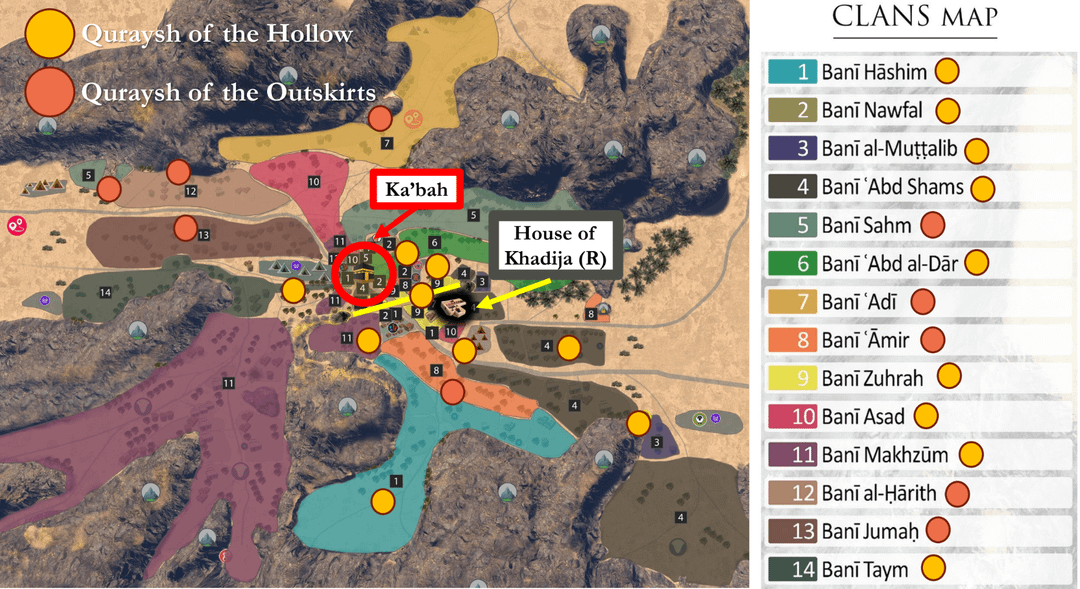
Note: Offices and leaderships varied over the years (Jahiliyya → beginnings of Islam). The names below reflect prominent figures around the time of Revelation.
| Clan | Group | Clan Chief (circa Prophet's time) |
|---|---|---|
| Banī Hāshim | Quraysh of the Hollow | Abū Ṭālib ibn 'Abd al-Muttalib |
| Banī Nawfal | Quraysh of the Hollow | Muṭʽim ibn ʿAdī |
| Banī al-Muṭṭalib | Quraysh of the Hollow | Al-Muttalib ibn 'Abd Manāf |
| Banī ʿAbd Shams | Quraysh of the Hollow | Harb ibn Umayya |
| Banī Sahm | Quraysh of the Outskirts | (Not clearly documented) |
| Banī ʿAbd al-Dār | Quraysh of the Hollow | 'Uthmān ibn Talḥa |
| Banī ʿAdī | Quraysh of the Outskirts | (Not clearly documented) |
| Banī ʿĀmir | Quraysh of the Outskirts | (Not clearly documented) |
| Banī Zuhrah | Quraysh of the Hollow | Sa'd ibn Abī Waqqāṣ |
| Banī Asad | Quraysh of the Hollow | (Not clearly documented) |
| Banī Makhzūm | Quraysh of the Hollow | Amr ibn Hishām (Abū Jahl) |
| Banī al-Ḥārith | Quraysh of the Outskirts | (Not clearly documented) |
| Banī Jumah | Quraysh of the Outskirts | 'Abū Lahab (for a time) |
| Banī Taym | Quraysh of the Hollow | Abū Bakr as-Siddīq |